
American Fork Directory Collections
The strongest verified American Fork city directory resources are a mix of local-history collections rather than a single continuous shelf. The city library links AFHS yearbooks through FamilySearch, American Fork Citizen issues through Utah Digital Newspapers, oral histories, historic-home files, and the Mountain West Digital Library. Marriott's Utah City Directories collection explains directory formats and offers digitized items, but the inspected 1900 view showed Ogden and Salt Lake examples, not a confirmed American Fork run.
| Collection | Verified years | Where held | Access |
|---|---|---|---|
| AFHS yearbooks | 1915-17; 1920-21; 1926-28; 1930-31; 1936; 1938; 1940-41; 1943-48; 1950; 1952-73 | City library link / FamilySearch | Digitized with gaps |
| American Fork Citizen | 1906-2009 | Utah Digital Newspapers | OCR and page image |
| Oral histories | Project gathered June 2015 | American Fork local-history page | Reference lead |
| Historic-home files | Not numerically stated | Library reference desk | Ask in person |
| Sanborn maps | 1890 and 1908 snapshots | LOC / Marriott | Digitized maps |
The gaps are part of the evidence. No official catalog page verified a complete American Fork publisher and year run. A secondary pointer to a 1904-1905 R.L. Polk Provo and Utah County title should be treated as a lead to verify at the library or FamilySearch catalog.
Where American Fork History Lives
The American Fork local-history page is the best starting desk. The city library is listed at 64 S 100 E, American Fork, 801-763-3070. Ask for local-history reference help, yearbooks, newspaper access, family-group sheets, funeral announcements, historic-building surveys, reverse directories, and obituary indexes. The pages do not publish a complete shelf list, so an in-person question with a surname, street, and approximate year is more reliable than assuming a gap means no item exists.
The FamilySearch American Fork Center at 110 E Main offers computers, discovery experiences, a photo-negative scanner, printers, and scanners. Listed hours are Sunday 4-8, Monday and Friday 9-5, Tuesday through Thursday 9-9, and Saturday closed. Walk-in service is noted. Library-supported access can help with digitized yearbooks and catalog searching, while copyright and collection access still vary.
The local-history page image points to the collection mix that makes an American Fork city directory search work even when the exact directory scan is missing.
American Fork High School Yearbooks
AFHS yearbooks are a useful family-reconnection source because they can place a student in a school year, class, organization, or portrait context. The official list includes 1915, 1916, 1917, 1920, 1921, 1926, 1927, 1928, 1930, 1931, 1936, 1938, 1940, 1941, 1943-48, 1950, and 1952-73. It does not establish that all years survive. It also does not represent every American Fork resident, since school populations and city boundaries differ.
Use a yearbook as a dated name and image clue. Save the exact year, page, class or group, and spelling. Then check an American Fork Citizen notice, cemetery entry, family file, or recorder record. A student who appears in an American Fork book may have lived outside the present city, so place and time still need confirmation.
Read the American Fork Citizen
The American Fork Citizen run from 1906 through 2009 can fill years where a city directory is absent. Search by surname, street, business, school, organization, funeral notice, marriage announcement, public meeting, and event. OCR can miss names or misread old type, so open the page image and save issue date and page. A newspaper item is strongest when its date, address, relationship, and independent record agree.
Newspaper research also helps explain a directory entry. An announcement may supply a spouse or parent. A business ad can connect a person to a street. A public meeting can show civic participation without proving residence. The city local-history page also points to royalty pictures from 1928-1983, Mountain West Digital Library material, and oral histories. Treat each as a lead with its own source date.
American Fork House Files and Oral History
The historic-home collection is unusually helpful for house history. The library reference desk holds family-group sheets, funeral announcements, building surveys, and collected histories, including some homes that have since been demolished. An address can therefore survive in a file after its structure is gone. Ask with the street, number, former owner, family name, or approximate period. The collection is not a public, indexed resident roll.
David Rawson Eagle's oral-history project gathered interviews in June 2015. Named participants include Bruce and Sandy Alger, Steven Bailey, Jo Ann Blanchard, Evan Brady, Chloe and Leo Freeman, Sharon Johnson, Warren McConnell, Dick Meacham, Gail Miles, Bill, Shelby and Tammy Pierce, Rollin Sattler, Anne Searle, Chuck Somerville, Eva and Loyd Wright. A known family, business, street, or event can guide the search. Corroborate memory with the newspaper, deed, cemetery, or vital route.
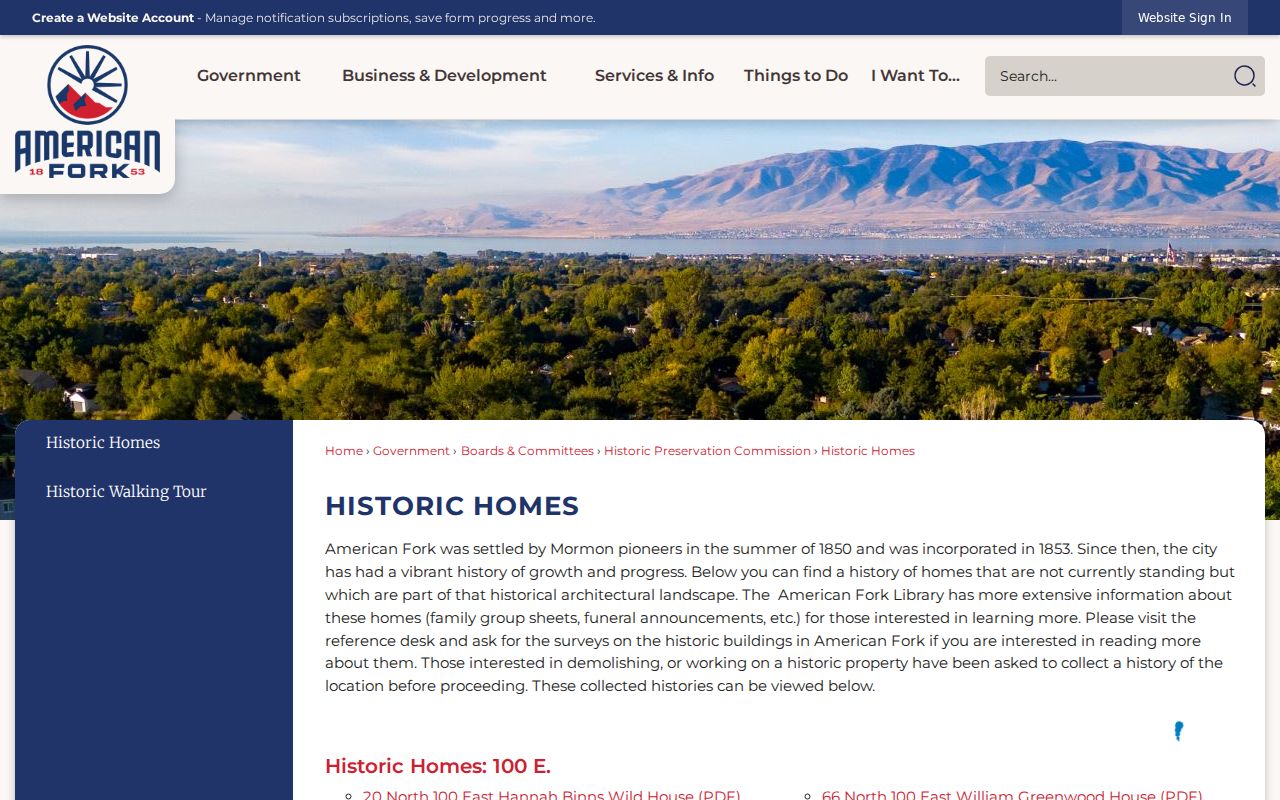
The official local-histories page is the source for the oral-history names and collection context. It is a lead bank, not a complete directory of residents.
What an American Fork Entry Can Carry
Marriott's collection description says city directories may list residents, streets, businesses, organizations, and institutions. Arrangements can be alphabetical, geographic, or by publisher, and advertisements add local context. A directory-format inspection can therefore suggest several fields without creating a fictional American Fork entry.
| Name | The listed person, household head, business, or institution. |
|---|---|
| Occupation | A work or business description when the volume includes one. |
| Address | House number and street, sometimes with a geographic or reverse section. |
| Household clue | A spouse, family link, owner or renter mark, or abbreviation may appear, but not in every run. |
| Publisher key | Arrangement and abbreviations should be read from that volume's own instructions. |
- Criss-cross directory
- A reverse arrangement that starts with street or address and points back to names.
- Householder index
- A name-focused finding aid for the person treated as the household contact.
- Abbreviation key
- The volume's guide to short forms and symbols. Photograph or note it before reading pages.
No readable local entry was available in the inspected official digital view. Label a future example as a directory-format inspection unless a library or FamilySearch scan supplies a real American Fork page.
Sanborn Maps and American Fork Streets
Sanborn maps put a building on a block without naming ordinary residents. The Library of Congress holds six American Fork sheets from 1890, and Marriott has a digitized local sheet from 1908. They show footprints, materials, uses, and street context. Pair a map with a directory street section, recorder legal description, newspaper announcement, or house file to test whether a structure and household belong together.
American Fork's name history can change a historical search. The area was settled in summer 1850, incorporated as Lake City on June 4, 1853, and renamed American Fork in 1860 to avoid mail confusion with Salt Lake City. McArthursville also appears in the state account. Search those forms when the collection supports it, then verify the county and place.
Tracing an American Fork Household
A city directory is a snapshot. Use it to build a dated sequence, then check what changed between available volumes. The same surname may be a different person, and disappearance may mean a move, death, omission, publication gap, or a changed listing practice.
- Start with a surname, given name, approximate year, and known American Fork street or family link.
- Read the alphabetical section and record exact spelling, occupation, address, and household marks.
- Repeat in the next available year, noting moves, additions, and missing years.
- Use a street or reverse section to compare nearby names when the volume provides one.
- Pair the result with an American Fork Citizen issue, yearbook, census, recorder abstract, cemetery, or house file.
The American Fork street directory page handles current address-keyed records. Historical city directories belong with the library, Archives, and FamilySearch shelf, while a recorder deed supplies recorded ownership rather than a complete household list.
American Fork Names Through Time
| Period | Best companion | What it adds |
|---|---|---|
| 1850-1869 | State history, family, church, early land leads | American Fork, Lake City, McArthursville variants |
| 1870-1905 | Recorder, Archives, maps, family collections | Recorded parties and physical setting |
| 1906-2009 | American Fork Citizen | Obituaries, notices, businesses, events |
| 1915-1973 listed years | AFHS yearbooks | Students, groups, portraits, school context |
The cemetery adds another local-history route. American Fork Cemetery covers 23 acres and about 23,500 plots, with a Names in Stone interment and map link. Its 1937-38 WPA wall is 1,580 feet long. Use an interment as a clue, then compare an obituary, vital record, family file, or directory. These details help reconnect a name to place without pretending the cemetery is a full resident index.
Recent library cooperation also matters. A June 2025 report described the Timpanogos Library Consortium joining American Fork, Highland, and Pleasant Grove libraries, building on cooperation since 2018. Check current catalog and reference rules before relying on the regional route.